Technical guide
Thermoelectric cooler: how it works and what buyers should verify
A thermoelectric cooler uses direct current to move heat through a module: one side becomes cold while the other must release heat. Airflow, insulation, ambient conditions, the load and the test method determine what a buyer can meaningfully compare.
Direct answer
A thermoelectric module transfers heat when direct current flows through it. Its cold side cools the enclosed space while its hot side needs fans and clear ventilation to reject heat. Reversing the current reverses those sides, but it does not remove the need to define the exact model and test conditions.
01 / Heat transfer
The thermoelectric module has a cold side and a hot side
The module sits between the cooled space and the outside heat-rejection path. With direct-current power applied, it moves heat toward one face. That creates a cold side facing the insulated interior and a hot side facing the outside of the product.
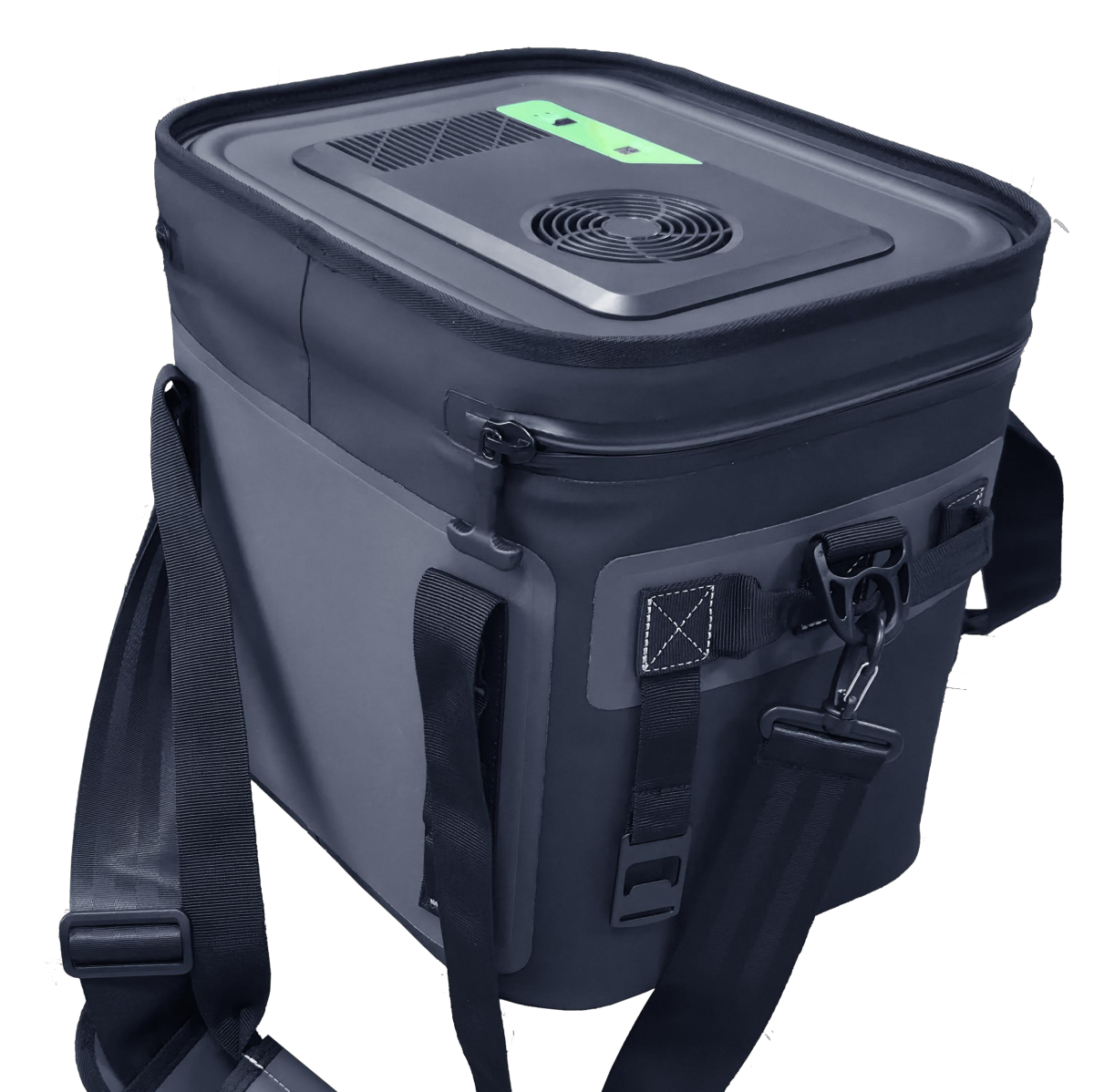
This is why a thermoelectric cooler is not judged only by the module. Its housing, heat-transfer surfaces, airflow path, insulation and operating setup all affect the outcome. The current portable electric cooler bag range shows a soft, portable product form; it does not establish one shared temperature or runtime result.
02 / Heat rejection
Fans, heat rejection and ventilation keep the hot side from being boxed in
The hot side has to discharge the heat it receives. Fans move air across the heat-rejection area, but that airflow needs room to enter and leave. Blocking the grille, pressing the product against another surface or placing it in a closed compartment changes the operating condition.
For a vehicle project, the location, cable reach and ventilation clearance should be reviewed together. The 12V cooler-warmer bag application guide turns those questions into a car-use brief rather than treating a vehicle outlet as the whole solution.
Air in
Keep the intake path clear of cargo, upholstery and packaging.
Heat out
Allow discharged heat to leave the surrounding space rather than recirculate.
Placement fixed
Record the position and clearance as part of the test setup.
03 / Measured conditions
Insulation, ambient temperature and load change what a test can show
Insulation slows heat exchange between the interior and the environment. It does not eliminate that exchange. A warmer environment, a warmer starting load, a heavier load, frequent opening or a longer access routine can all change the measured result.
Ask whether the test began with an empty interior or a defined load, whether the contents were already cool or warm, where temperatures were measured and how long the product ran. Without those conditions, a claimed result cannot be compared fairly across suppliers or product forms.
| Factor | Why it changes the test | What to record |
|---|---|---|
| Ambient condition | It sets the heat the system must manage. | Temperature and the test location |
| Load | Contents bring their own starting condition and heat mass. | Type, amount and starting condition |
| Access routine | Opening exchanges interior air with ambient air. | Opening sequence and duration |
| Airflow | Hot-side heat rejection depends on clear ventilation. | Clearance and surrounding arrangement |
04 / Mode direction
Cooling and warming reverse the direction of heat transfer
In a thermoelectric cooler and warmer, reversing the electrical direction reverses which face is cold and which face is hot. The same general module principle can therefore support cooling or warming operation, provided that the selected design and power controls are made for that mode.
Do not turn the principle into a product promise. Buyers should confirm the exact power input, plug, cable, controller, mode indication, operating instructions and supplied components for the selected soft thermoelectric cooler and warmer bag.
05 / Physical form
A soft cooler bag and a powered cooler box are different product forms
A soft cooler bag is designed around flexible carrying structure, a zipper opening, handles or a strap, insulation and an external powered module. A rigid powered cooler box is a general market term for a hard-sided container. The construction, loading pattern, portability, protection and usable interior geometry should be evaluated separately.
Pertemba's current documented product evidence is the soft bag form. This distinction matters when a buyer is comparing market concepts: a discussion of a rigid box is not evidence that Pertemba supplies one. For the procurement questions that keep those forms and claims separate, use the powered cooler box buying guide.
06 / Procurement evidence
Verify the product data before comparing performance
The information gain in this guide is a comparison-ready evidence checklist. It keeps a supplier discussion tied to the exact sample rather than to a bare cooling claim or a reference value from another form.
Identify the exact product.
Confirm the model code, product form, usable internal dimensions, included components and current technical sheet.
Define the electrical package.
Confirm input, connector, cable, controller, modes, power consumption, vehicle compatibility and what is included.
Request one reproducible test record.
Record ambient condition, starting load, load amount, placement, ventilation, opening routine, duration and measurement points.
Match the evidence to the public claim.
Ask for instructions and relevant product records that apply to the selected configuration, intended market and proposed wording.
Buyer FAQ
Questions about how a thermoelectric cooler works
Does a thermoelectric cooler make cold by itself?
No. A thermoelectric module moves heat from one side to the other when supplied with direct current. The hot side still needs a clear path to release that heat.
Why can two tests of the same cooler give different results?
Ambient temperature, the starting condition and amount of the load, insulation, airflow, power input, access routine and test duration all change the result.
Can cooling and warming use the same module?
In a thermoelectric system, reversing the electrical direction reverses which side becomes cold and which becomes hot. The exact controls and power package must be confirmed for the selected model.
What should a buyer request before using a performance claim?
Request the exact model, test method, ambient condition, starting load, load amount, duration, airflow arrangement, power input, measurement points and the supporting record.
Apply the principle
Turn the heat-transfer principle into a product brief
Review the documented soft bag form, then define the vehicle setup, load, power package, ventilation and evidence you need from the exact sample.
Prepare a comparable test
Discuss the load, airflow and evidence required for your cooler-bag brief
Share the intended contents, placement, power source, soft-bag requirements, operating routine and the product data your team needs to verify. First separate the mechanisms with the thermoelectric versus compressor cooler comparison.